


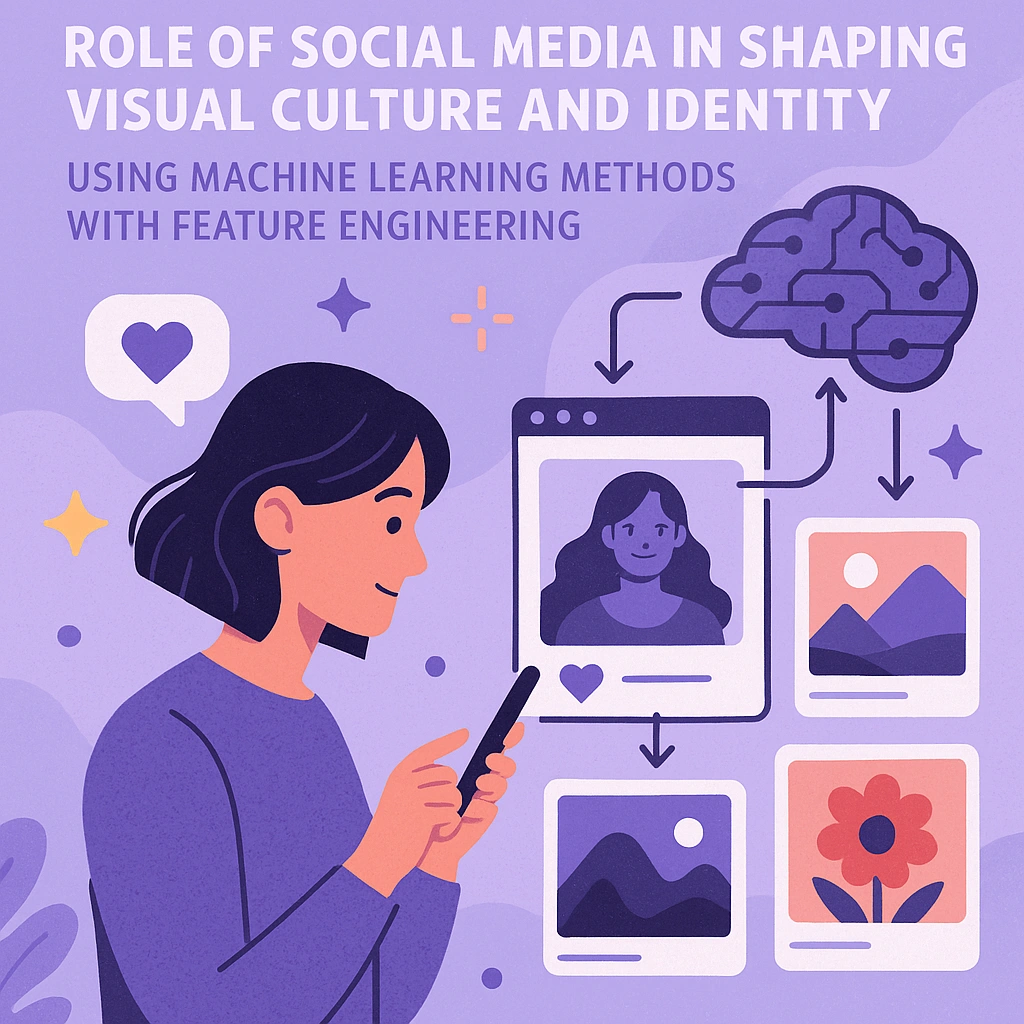
In today’s hyperconnected digital era, social media platforms like Instagram, TikTok, Snapchat, and Pinterest are more than tools of communication — they are engines of visual culture. Every filter, trend, hashtag, or influencer post not only reflects but actively shapes the way people perceive beauty, lifestyle, identity, and even truth.
But beyond the selfies and stories lies a sophisticated infrastructure of machine learning algorithms and feature engineering techniques that govern what we see, how we see it, and — more crucially — how we come to see ourselves.
This article dives deep into how social media and AI intersect to craft, curate, and sometimes commodify visual culture and identity. It also explores how machine learning models and feature engineering decode and even influence the aesthetics and social behavior that define modern digital life.
📲 Visual Culture in the Social Media Age
Visual culture refers to the shared meanings communicated through visual images — a concept now accelerated by billions of daily uploads to platforms driven by visual content. Whether it’s aesthetic feeds on Instagram, dance challenges on TikTok, or avatar-driven interactions on Snapchat, social media promotes and proliferates visual norms at unprecedented speed and scale.
What distinguishes today’s visual culture is its algorithmic mediation — our exposure to certain images is not random but carefully filtered, ranked, and recommended by AI-driven systems designed to maximize engagement.
🧠 Machine Learning: The Hidden Architect
At the core of these platforms lies machine learning (ML) — a subset of artificial intelligence that learns patterns from data and uses them to make predictions or decisions.
Here’s how ML operates behind the scenes on social media:
-
Content recommendation: Algorithms learn user preferences to show more engaging or relevant content
-
Facial recognition and tagging: Automated systems identify people in photos
-
Aesthetic prediction: AI evaluates images based on color, symmetry, composition, etc., to determine “visual appeal”
-
Style transfer and filters: ML modifies user-generated content to match popular trends
The result? Machine learning doesn’t just serve our preferences; it shapes them.
🔧 Feature Engineering: Decoding the Visual
To make machine learning models effective, feature engineering plays a critical role. Feature engineering involves selecting, modifying, and transforming raw data (like images or user behavior) into formats that machine learning algorithms can understand.
In the context of social media and visual culture, the features used may include:
-
Visual Features:
-
Color palette (warm vs. cool tones)
-
Texture (smooth, grainy)
-
Symmetry and framing
-
Use of filters or effects
-
-
Behavioral Features:
-
Likes, comments, and shares
-
Time spent on image or video
-
Follower engagement over time
-
-
Semantic Features:
-
Objects or people detected in images
-
Hashtags and captions used
-
Sentiment of comments
-
By analyzing these features, ML models can determine the virality of a post, infer mood, or even cluster users based on their aesthetic tastes — giving rise to communities driven by algorithmically endorsed visual styles.
📸 Constructing Identity in the Age of AI
One of the most profound impacts of social media and ML is in the realm of personal and social identity formation. People increasingly construct their identities through images, curated and filtered to align with trending aesthetics or personal brands.
Machine learning models reinforce certain identity traits by amplifying some visuals and suppressing others. For example:
-
Beauty norms: Images that align with Eurocentric or hyper-edited beauty standards often get more visibility due to algorithmic patterns learned from user behavior.
-
Cultural representation: Some cultural visuals are underrepresented or misrepresented due to biased training data.
-
Gender expression: ML models often categorize or predict gender presentation based on historical norms, which can marginalize fluid or non-conforming identities.
This algorithmic reinforcement of identity can both empower users to find community and pressure them to conform to dominant visual standards.
🌍 Globalization of Aesthetics
Through platforms like Instagram or TikTok, global aesthetics are rapidly homogenized, creating what some researchers call a “platform aesthetic” — where color tones, facial expressions, and visual layouts look similar regardless of geography.
Machine learning plays a central role in this process:
-
AI rewards certain visual compositions with more visibility
-
Influencers across cultures begin to imitate the styles that “go viral”, leading to a feedback loop
-
Augmented reality (AR) filters, powered by computer vision and deep learning, add another layer of uniformity to digital self-expression
While this global aesthetic may connect people, it can also erode local cultural expressions and unique visual languages.
💬 The Role of Deep Learning in Visual Interpretation
Recent advancements in deep learning, particularly in convolutional neural networks (CNNs), have made it possible for machines to understand complex visual signals like facial emotion, scene context, or even perceived attractiveness.
In social media:
-
Instagram’s Explore Page uses CNNs to recommend visually similar content
-
TikTok’s “For You” feed uses multilayered neural networks to analyze user interaction and content themes
-
Pinterest’s Lens tool uses deep learning to visually search and suggest related pins
By pairing deep learning with human engagement metrics, social platforms optimize for visual content that provokes attention, emotion, or consumption — a model that shapes not just what we see but what we aspire to look like.
⚠️ Ethical Considerations and Cultural Impact
While powerful, the intersection of machine learning, social media, and visual culture raises a host of ethical questions:
-
Bias and Discrimination
Algorithms trained on biased datasets may underrepresent people of color, reinforce beauty stereotypes, or marginalize non-Western cultural norms. -
Mental Health Effects
The promotion of “perfect” imagery has been linked to body image issues, anxiety, and depression, especially among teens. -
Surveillance and Privacy
Feature-engineered models that identify faces, emotions, or objects can be used for intrusive surveillance without user consent. -
Cultural Homogenization
AI-driven visual curation may lead to the erosion of diverse storytelling, replacing it with commercial aesthetics.
🧪 Case Studies and Research Frontiers
📍Case Study 1: Instagram and Filter Usage
Researchers from MIT and the University of Amsterdam studied how filter choices correlated with likes. They found that photos with warmer filters and higher contrast gained more engagement — insights now baked into recommendation engines.
📍Case Study 2: TikTok’s Algorithm
TikTok’s algorithm predicts engagement based on frame-by-frame visual changes, expression detection, and sound interaction. This leads to hyper-personalized content that shapes user attention, identity, and creativity in tight feedback loops.
📍Case Study 3: Identity Recognition through ML
Tools like DeepFace (Facebook) or Amazon Rekognition can identify not just individuals, but inferred attributes like age, mood, and ethnicity, raising alarms on algorithmic profiling and privacy.
🔮 The Future: Toward Ethical AI in Visual Culture
As we move forward, scholars, developers, and policymakers must rethink how feature engineering and ML models influence cultural identity. Some key recommendations include:
-
Algorithm transparency: Users should know why they’re seeing specific content
-
Inclusive training datasets: Models must reflect cultural, racial, and aesthetic diversity
-
User agency: Platforms should allow more control over algorithms
-
Ethical design: Engineers must prioritize well-being and representation, not just engagement metrics
📝 Conclusion: Seeing Ourselves Through Algorithms
Social media is no longer just a stage for self-expression — it’s a mirror shaped by machine learning. Through complex networks of feature engineering and visual processing, these platforms curate reality, determine visibility, and influence the aesthetics of selfhood.
Understanding this evolving landscape is not just a technical challenge, but a cultural imperative. If we are to maintain agency in how we see — and are seen — in the digital world, we must rethink the design, data, and ethics of the systems that shape our visual lives.
Read More: uploadarticle.com
❓FAQs
Q1: What is feature engineering in the context of social media and ML?
Feature engineering involves transforming raw visual and behavioral data (like image contrast, engagement time, hashtags) into numerical formats that machine learning models can analyze and learn from.
Q2: How do social media algorithms affect personal identity?
By promoting specific types of images, beauty standards, and cultural aesthetics, algorithms influence how users present themselves and what identities gain visibility or engagement.
Q3: Can machine learning promote diverse visual cultures?
Yes — if trained on inclusive datasets and designed with equity in mind, ML can surface underrepresented visuals, languages, and identities, rather than suppress them.
Read More: